As we navigate the complexities of modern life, the quest for inner peace has never been more urgent. In Maharishi Mahesh Yogi's profound teachings on different states of consciousness, the fourth state of consciousness needs to be talked about more in detail, as it is the bedrock from where our daily life gains substance as well as the access to higher states of consciousness truly begins.
On this World Meditation Day, let's explore how Transcendental Meditation unlocks this higher state of awareness, offering more than personal transformation but a pathway to collective harmony.
What is the Fourth State of Consciousness in meditation? It's the silent, boundless field of pure consciousness that lies beyond everyday experience, inviting us all to a deeper understanding of our true nature.
World Meditation Day - A Growing Need for Peace in an Increasingly Anxious World
World Meditation Day, observed annually on December 21, marks a pivotal moment in the global calendar, proclaimed by the United Nations in 2024 to raise awareness about meditation's transformative benefits.
This date, aligning with the winter solstice, symbolizes a turning point from darkness to light—a fitting metaphor for the inner illumination meditation provides.
The history of World Meditation Day traces back to calls from spiritual leaders and wellness advocates across cultures, honoring figures like Guru Dev Swami Brahmananda Saraswati, the revered teacher of Maharishi Mahesh Yogi, whose legacy underscores meditation's role in fostering peace.
What began as grassroots initiatives has evolved into a meditation day global movement, uniting millions across continents in synchronized practice.
The importance of World Meditation Day cannot be overstated in our era of relentless connectivity and mounting stressors. From the 2020 pandemic's lingering mental health echoes to today's geopolitical tensions and climate anxieties, the world grapples with unprecedented levels of unease.
According to global surveys, anxiety disorders affect over 300 million people, with burnout rates soaring in workplaces worldwide. Yet, amid this chaos, meditation emerges as an increasingly essential, easily available personal stress relief and wellness tool.
Unlike rigid exercise regimens or therapy sessions that demand time and resources, Transcendental Meditation (TM) requires just 20 minutes twice daily, making it accessible to beginners and busy professionals alike.
On World Meditation Day, we celebrate this democratization of inner peace. It's a reminder that in an anxious world, the 'real' turning inward shouldn't be with the feeling of escapism—it's empowerment. By cultivating higher states of consciousness through practices like TM, individuals contribute to a ripple effect of calm, reducing societal discord - one breath at a time.
As Maharishi’s teachings on consciousness emphasize, true peace begins when we access the unified field of pure consciousness within, shifting our lives from personal turmoil to collective serenity. This day calls us to pause, reflect, and meditate, honouring the growing need for tools that not only soothe the mind but also fortify the spirit against modern life's tempests.
The Fourth State of Consciousness - Transcendental Consciousness
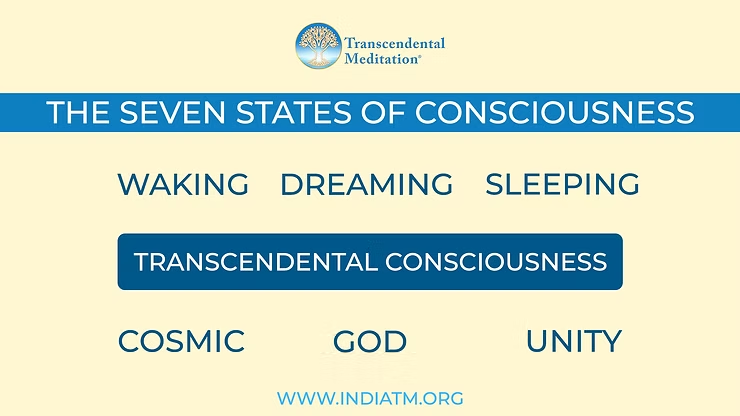
In Maharishi Mahesh Yogi's visionary framework, human evolution unfolds through seven states of consciousness, each building upon the last to reveal our infinite potential. The first three states of consciousness —waking (Jagrat Chetna), dreaming (Swapn Chetna), and sleep(Sushupti Chetna) —are familiar to all, cycling through our daily rhythms but leaving us fragmented and unfulfilled.
Waking consciousness filters reality through the senses, often clouded by distractions; dreaming weaves illusions from subconscious stirrings; and sleep offers deep rest, but without awareness. These states, while necessary, bind us to the surface levels of mental function, perpetuating limitation and thus stress and unfulfillment.
Enter the fourth state of consciousness : Transcendental Consciousness, the bedrock of attaining higher states of consciousness. This is no mere altered state but a foundational reality, a silent reservoir of pure being that Maharishi described as the "settled state of the mind."
Unlike the activity of waking, the narratives of dreaming, or the inertia of sleep, Transcendental Consciousness is characterized by restful alertness—profound quietude paired with unbounded awareness. Here, the mind transcends thought, dipping into the source from where all experience arises.
In Vedic literature, this fourth state of consciousness is revered as Turiya, the "fourth," and Samadhi, the state of complete absorption. Ancient sages proclaimed it as the gateway to enlightenment, distinct from the triad of ordinary states.
A deeply laden verse from the Mandukya Upanishad encapsulates its essence: "Shivam shantam advaitam chaturtham manyante, sa atma sa vigyeyaha." Translated, it reads: "Blissful, peaceful, non-dual—they consider the fourth; that is the Self, that is to be known."
From Maharishi Mahesh Yogi's perspective, this verse unveils the divine anatomy of the Self.
"Shivam" signifies auspiciousness and bliss, the inherent joy that permeates existence when we settle into pure consciousness—far from the fleeting pleasures of the world.
"Shantam" evokes eternal peace, a silence beyond the noise of thoughts, where the mind's turbulence dissolves into stillness.
"Advaitam" points to non-duality, the unified wholeness that erases separations between self and universe, subject and object. "Chaturtham" affirms its position as the fourth state of consciousness, transcending yet encompassing the other three.
Finally, "sa atma sa vigyeyaha" declares this as the true Self, the Atman, worthy of direct realization—not through intellect, but through effortless transcendence.
Maharishi emphasized that knowing this fourth state isn't intellectual; it's experiential. The Self is always there, but veiled by the activity of the mind. Transcend, and the veil lifts.
This realization propels us toward the fifth state (Cosmic Consciousness or Turiyateet Chetna), sixth (God Consciousness or Bhagvad Chetna), and seventh (Unity Consciousness or Brahmi Chetna), where individuality merges with the cosmic whole.
On World Meditation Day, reflecting on Turiya reminds us: the fourth state of consciousness isn't esoteric—it's our natural birthright, awaiting discovery, within.
How can one experience the Fourth State of Consciousness
While there could be a number of ways to experience this fourth state of consciousness, but a systematic and regular experience is what stabilizes it most effectively. At the heart of Maharishi's teachings lies Transcendental Meditation, a simple yet profound technique designed to effortlessly let the practitioner experience the fourth state of consciousness, the unbounded, silent, vast transcendental reality. From where we are, thoughts buzz like the notifications on our phones—plans, worries, memories vying for attention and the possibility of such a stage seems impossible. The simple, scientific and time tested technique of TM makes it possible, that too without control or force.
The process of TM is akin to a submarine diving to the tranquil depths of the ocean. It uses the natural tendency of the mind to experience higher states of bliss and peace to turn it inward toward its source, which is the only permanent, infinite reservoir of silence, peace and happiness.
The mind's transition from gross to the refined strata is a natural one: This effortless progression mirrors the mind's evolutionary architecture, peeling away the veils of agitation.
This is the experience of pure consciousness: unbounded, eternal, and self-referral. No content, no effort—just the essence of awareness itself.
We thus experience Turiya, a stable platform of restful wakefulness that infuses daily life with clarity and poise. Regular practice stabilizes this access, transforming fleeting glimpses into a permanent higher state of awareness.
Maharishi likened it to a river merging with the ocean: the individual stream loses its turbulence, gaining the vastness of the sea. Through Transcendental Meditation, anyone—regardless of background—can effortlessly chart this course, making transcendental consciousness not a distant peak, but an accessible horizon.
On World Meditation Day, embracing Transcendental Meditation invites us to this inner voyage, where personal enlightenment becomes the foundation for personal growth and global harmony.
How the Fourth State of Consciousness Is Essential for Overall Wellbeing
Accessing the fourth state of consciousness through Transcendental Meditation creates a state of restful awareness that revolutionizes wellbeing from the inside out.
At its core, this state induces unparalleled deep rest—deeper than sleep—dissolving deep-rooted stress accumulated over years. Physiological markers plummet: cortisol levels drop by up to 30%, blood pressure normalizes, and the body's repair mechanisms accelerate.
Rejuvenation follows, with practitioners reporting increased energy, faster healing, and a youthful vitality that defies chronological age.
Cognitively, this state expands the mind's horizons. Brainwave coherence synchronizes disparate regions—the prefrontal cortex lights up in harmony, enhancing creativity, focus, and problem-solving.
Studies show TM practitioners exhibit improvement in IQ, EQ and SQ scores as the unified field of awareness integrates fragmented thoughts into a seamless and evolutionary insight.
Harmonization ripples through the body: endocrine balance stabilizes, immune function strengthens, and cardiovascular health improves, reducing heart disease risk by 48%. Behaviorally, it cultivates equanimity—irritability fades, relationships deepen, and ethical choices flow naturally from a place of inner fullness.
In essence, this isn't just an add-on; it's the foundation stone of holistic wellness. By expanding consciousness states, it addresses the root of imbalance offering sustainable relief.
What Happens When Many People Experience the Fourth State of Consciousness Together?
When individuals practice TM in groups and experience the fourth state of consciousness together, the impact amplifies exponentially—a phenomenon social scientists termed the ‘Maharishi Effect’ in honour of Maharishi, who postulated its existence after an analysis of Yogic texts.
This isn't mysticism; it's a measurable field effect of consciousness, where group practice of Transcendental Meditation and advanced TM-Sidhi techniques generates a sphere of coherence or orderliness, influencing the collective psyche and the environment.
The principle hinges on the square root of 1% rule: when approximately that number of a population practices advanced techniques of TM, the TM-Sidhi Program together, societal stress decreases, thinking becomes harmonized, negative tendencies go down and positive occurrences increase within the sphere of influence.
Scaled nationally, this creates non-local or pervasive effects, reducing conflict and enhancing harmony. Scientifically validated through numerous studies, the Maharishi Effect stands as a sociological breakthrough, proving group meditation as an effective strategy for lasting world peace.
A notable example is the national TM-Sidhi Program group assembly in the United States between 2007 and 2010, known as the Invincible America Assembly.
During this period, a large group of advanced practitioners gathered, exceeding the required threshold (around 1,725 for the U.S. population). Researchers observed a significant reversal in rising violent crime trends, with a 21.2% reduction in the national homicide rate compared to the baseline period of 2002–2006, preventing an estimated 8,157 homicides or murders.
In a sample of 206 major urban areas, murder rates dropped by 28.4%, averting thousands of deaths, with statistical significance (p < 10^{-13} in related analyses).
Visualizing this, consider the following chart depicting the shift in U.S. urban homicide rates before and during the assembly period:
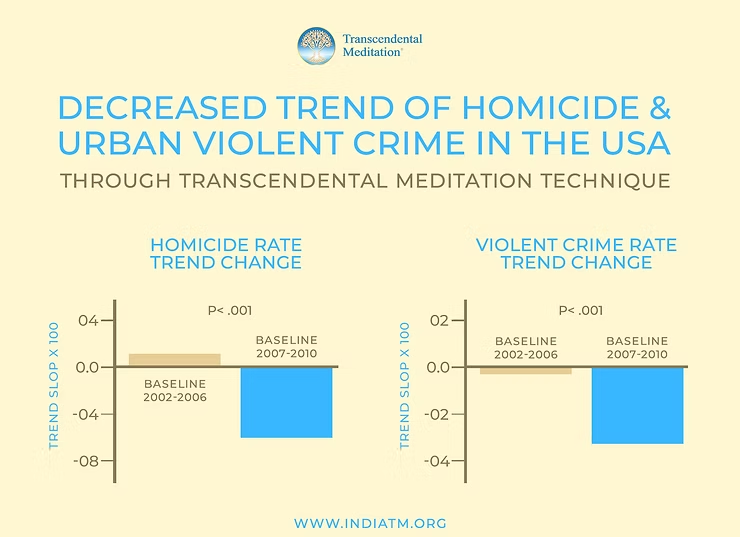
The downward trend post-2007, contrasting the prior rise, underscores the coherence effect. Such data affirms: collective transcendence fosters peace.
Conclusion
On this World Meditation Day, we've journeyed through the fourth state of consciousness —Transcendental Consciousness, or Turiya—as illuminated by Maharishi Mahesh Yogi's seven states of consciousness framework.
Revealed in Vedic texts and experienced directly through the technique of Transcendental Meditation, this higher state of awareness offers restful rejuvenation and profound wellbeing benefits.
When embraced collectively, it manifests the Maharishi Effect, which demonstrates its power to heal societies, as seen in the transformative reductions in crime and homicide rates in the United States during the 2007-2010 TM-Sidhi Program assembly.
As anxiety grips our world, let World Meditation Day inspire us to transcend—to dive into pure consciousness and emerge renewed. In Maharishi’s words, "The world is as we are. Whatever value of consciousness that is the value of the world for us." Cultivate the fourth state, and watch peace unfold, within and out.